Statistics

Producing IQR and Outlier statistics with SQL
The interquartile range (IQR) measures the spread of the middle 50% of a distribution — the distance between the first quartile (Q1) and the third quartile (Q3). Combined with Tukey’s 1.
Read more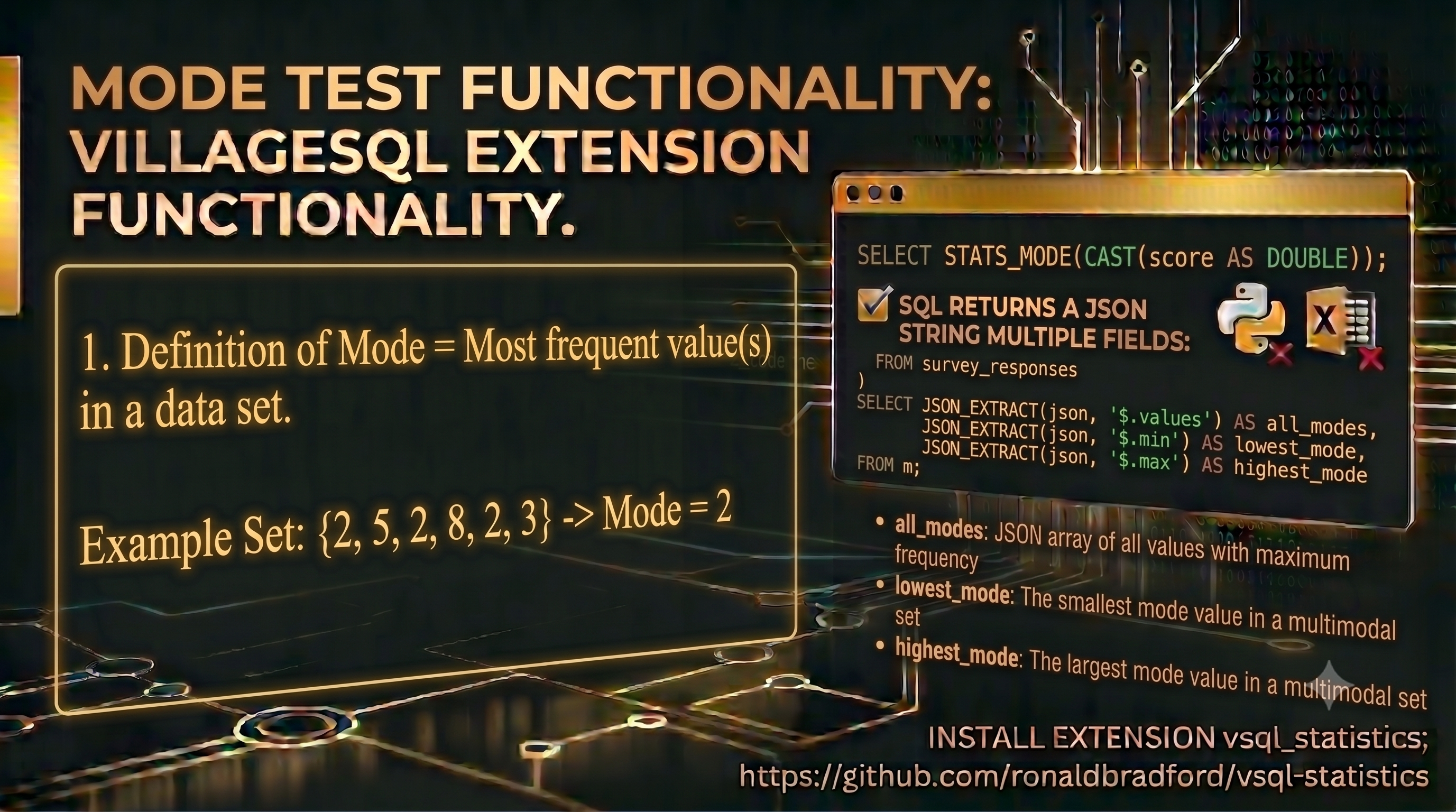
Producing Mode statistics with SQL
The mode is the value or values that appear most frequently in a dataset. Unlike the mean or median, it applies naturally to categorical and ordinal data — star ratings, product codes, survey responses — and reveals what is most common, not what is average.
Read more
Producing Alternative Means statistics with SQL
MySQL’s built-in AVG() computes the arithmetic mean — the sum divided by the count. That is the right default for many questions, but it is not always the right measure of central tendency.
Read more
Producing One-Sample Z-Test statistics with SQL
The one-sample Z-test determines whether a sample mean differs significantly from a known population mean when the population standard deviation is also known. It is the appropriate test when the population parameters are established — quality control benchmarks, national averages, long-run process measurements — and you want to evaluate whether a new sample is consistent with them.
Read more
Producing Skewness statistics with SQL
Skewness measures the asymmetry of a distribution. A perfectly symmetric distribution has a skewness of zero. A positive skew (right-skewed) means the tail extends to the right — a small number of high values pull the mean above the median.
Read more
Producing Chi-Squared statistics with SQL
The Chi-Squared test is one of the most widely used statistical tests for categorical data. It comes in two flavors: the goodness-of-fit test asks whether an observed frequency distribution matches an expected one, while the test of independence asks whether two categorical variables are associated with each other.
Read more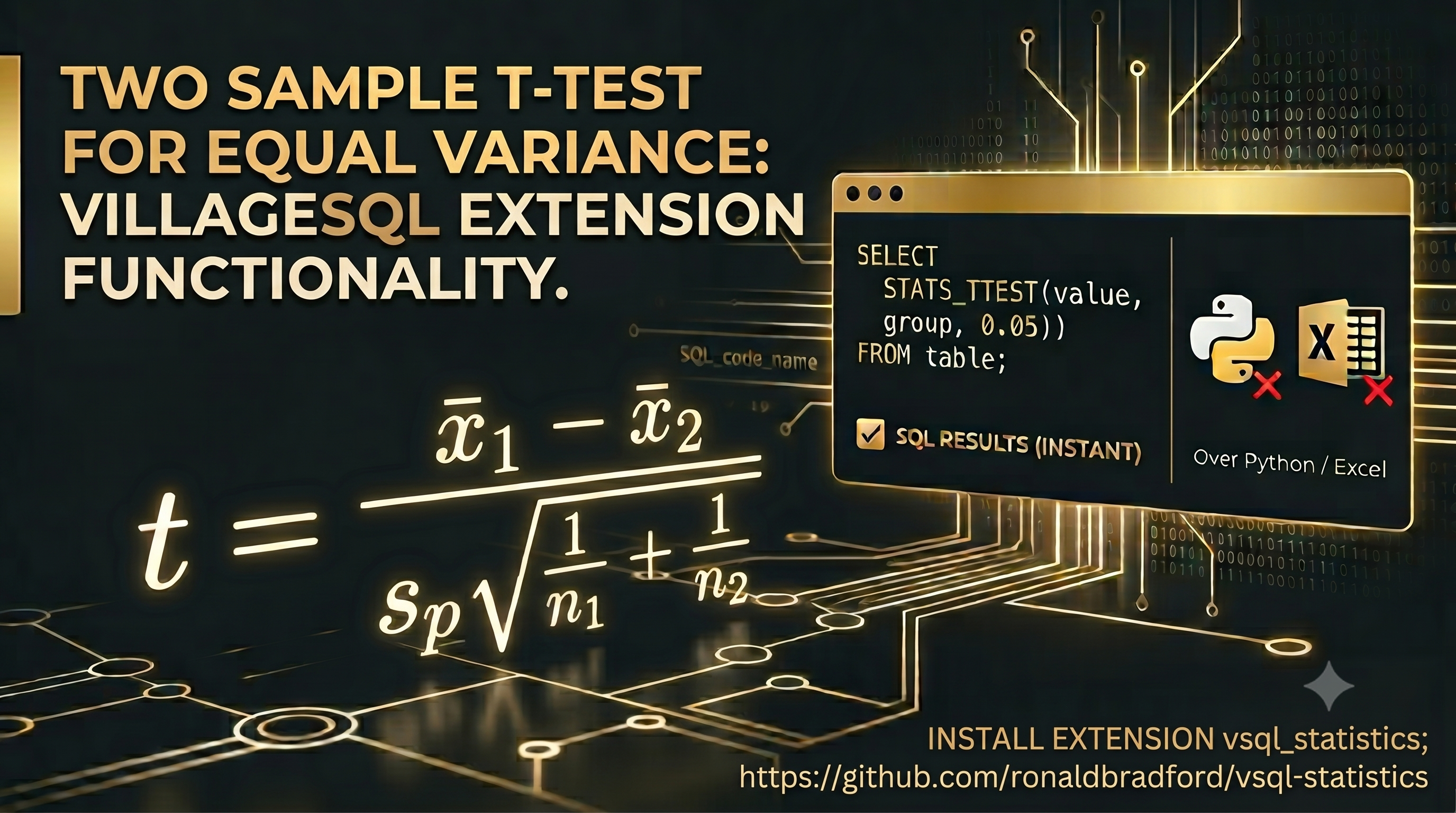
Producing Two Sample T-Test statistics with SQL
The two sample t-test for equal variance is a statistical test to determine if the means of two groups are different enough that the difference is likely caused by some underlying difference, rather than random chance.
Read more