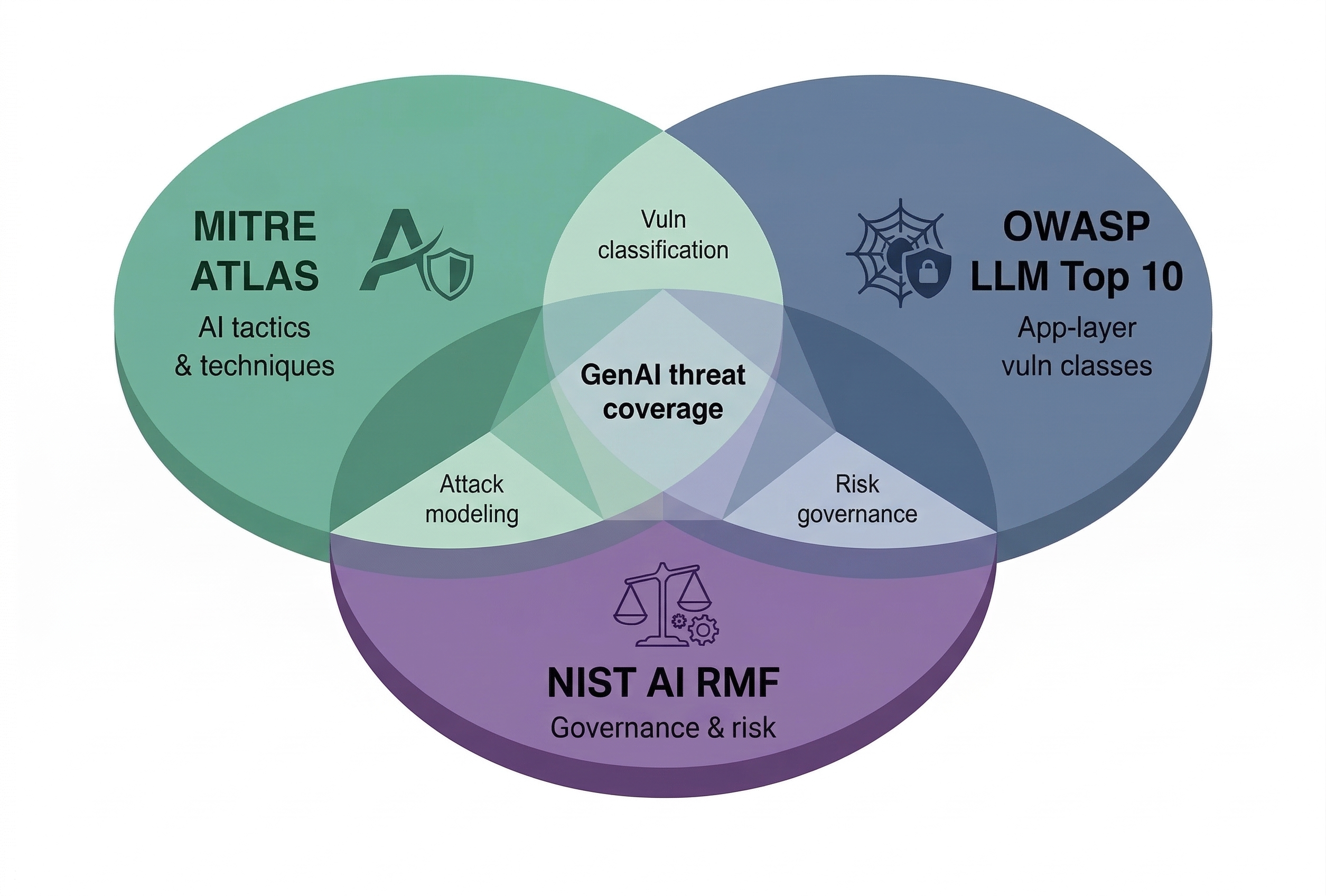
Three frameworks form the analytical foundation of this series’ threat analysis, selected for their complementary coverage of the GenAI security landscape and their broad adoption across enterprise security practices. The MITRE Adversarial Threat Landscape for AI Systems (MITRE ATLAS) maps tactics and techniques specific to AI systems. The Open Worldwide Application Security Project (OWASP) Top 10 for Large Language Models (LLM) classifies application-layer risks directly relevant to production LLM deployments. Finally, the National Institute of Standards and Technology (NIST) AI Risk Management Framework (AI RMF) provides the organizational governance and structure within which frameworks operate. These three frameworks represent the most widely adopted, actively maintained, and comprehensively scoped foundations for enterprise GenAI security practice. Additional resources including the MIT AI Risk Repository contribute valuable supplementary context and are also referenced.
MITRE ATLAS
The MITRE Adversarial Threat Landscape for AI Systems (ATLAS) extends the well-established MITRE ATT&CK model into the domain of artificial intelligence. Where ATT&CK catalogs the tactics and techniques adversaries use against traditional systems, ATLAS documents how those same adversaries reconnoiter, gain access to, and manipulate machine learning and GenAI systems.
ATLAS is organized around tactics (the adversary’s objective, such as reconnaissance, initial access, or exfiltration) and techniques (the specific methods used to achieve each objective). Because it mirrors the structure security teams already know from ATT&CK, it lowers the barrier to reasoning about AI-specific threats using familiar mental models. For GenAI systems, ATLAS captures attack patterns such as prompt injection, model evasion, training data poisoning, and model theft, and it links many entries to real-world case studies.
OWASP Top 10 for LLMs
The OWASP Top 10 for Large Language Model Applications narrows the focus to the application layer, where most production LLM deployments actually live. Following the pattern of the long-running OWASP Top 10 for web applications, it ranks the most critical and prevalent risks that teams building on top of LLMs need to address.
The list covers risks that are directly actionable for developers and application security teams, including prompt injection, insecure output handling, training data poisoning, model denial of service, supply chain vulnerabilities, sensitive information disclosure, insecure plugin design, excessive agency, overreliance, and model theft. Its value lies in its immediacy: each risk maps cleanly to design decisions, guardrails, and controls that can be implemented in the LLM application itself.
NIST AI Risk Management Framework
The NIST AI Risk Management Framework (AI RMF) operates at a different altitude. Rather than enumerating specific attacks, it provides the organizational governance and structure within which the other frameworks operate. The AI RMF is built around four core functions: Govern, Map, Measure, and Manage.
- Govern establishes the culture, policies, and accountability that underpin responsible AI risk management.
- Map provides the context needed to identify and frame risks for a given AI system and its use.
- Measure applies quantitative and qualitative methods to analyze, assess, and track those risks.
- Manage allocates resources and prioritizes actions to treat the risks that matter most.
By supplying this governance scaffolding, the AI RMF ensures that the tactical insights from ATLAS and OWASP are applied within a repeatable, accountable, and organization-wide process rather than as one-off technical fixes.
Complementary Coverage
These three frameworks were chosen deliberately because they reinforce one another rather than overlap.
| Framework | Primary Focus | Level |
|---|---|---|
| MITRE ATLAS | Adversary tactics and techniques against AI systems | Threat intelligence |
| OWASP Top 10 for LLMs | Application-layer risks in production LLM deployments | Application security |
| NIST AI RMF | Organizational governance and risk management structure | Governance |
Read together, ATLAS explains how adversaries attack AI systems, the OWASP Top 10 explains what to defend in the applications themselves, and the NIST AI RMF explains how an organization should govern and manage the resulting risk. This layering, threat intelligence, application security, and governance, is what makes them a strong analytical foundation for the threat analysis that follows in this series.
Supplementary Resources
Beyond the three core frameworks, the MIT AI Risk Repository provides a valuable supplementary reference. It aggregates and categorizes AI risks from across the literature into a structured, searchable database, offering breadth and context that complements the more prescriptive guidance of ATLAS, OWASP, and NIST. Where relevant, this and other resources are referenced throughout the series to add depth to specific threats.
Summary
MITRE ATLAS, the OWASP Top 10 for LLMs, and the NIST AI RMF together provide complementary coverage across threat intelligence, application security, and governance. They are the most widely adopted, actively maintained, and comprehensively scoped foundations for enterprise GenAI security practice, and they form the analytical lens through which the remainder of this series examines GenAI threats.