XP January Meeting

The Brisbane XP Group met yesterday for a presentation by Dr Paul King of Asert on the book Sustainable Software Development : An Agile Perspective.

  <p>
    I found it a good time to get a collective opinion and review of the techniques and methods we are moving towards in Software Development. Indeed one key point better describing Pair Programming has been added to my upcoming conference presentation <a href="http://www.arabx.com.au/articles.htm">Overcoming the Challenges of Establishing Service and Support Channels</a>. I&#8217;m hoping Paul makes his notes available as a review of this book, that I will also mention in my presentation.
  </p>
  
  <p>
    In Review, this is some of the key points I got from this presentation.
  </p>
  
  <ul>
    <li>
      Software gradually degrades over time, and will become a maintenance nightmare
    </li>
    <li>
      Successful software will be changed again and again
    </li>
    <li>
      The IT industry has a problem historically with credibility
    </li>
  </ul>
  
  <p>
    So the goal is to move towards <b>Sustainability</b>. Some of the points mentioned by Paul were:
  </p>
  
  <ul>
    <li>
      Continual refinement
    </li>
    <li>
      A working product at all times (not just working software)
    </li>
    <li>
      Value Defect Prevention over Defect Detection
    </li>
    <li>
      Additional investment and emphasis on design
    </li>
  </ul>
  
  <p>
    On point I struggle with is <a href="http://www.extremeprogramming.org/rules/pair.html" target="_blank">Pair Programming</a>. I don&#8217;t struggle with the concept, it&#8217;s great and really works. The struggle is selling <a href="http://www.extremeprogramming.org/rules/pair.html" target="_blank">Pair Programming</a> as a core XP Principle. Some good points of discussion lead to a better angle.
  </p>
  
  <ul>
    <li>
      Pair Programming &#8211; should be de-emphasised as a key point
    </li>
    <li>
      By selling Defect Prevention and using Continuous Code Reviews as one method of implementing this
    </li>
    <li>
      Continuous Code Review are achieved with Pair Programming
    </li>
  </ul>
  
  <p>
    Much easier. The key point is management understands the term <b>Code Reviews</b>, and if you can show the effect of Defect Prevention on support costs, using Pair Programming, Refactoring and other techniques, your sales pitch will be easier.
  </p>
  
  <p>
    Also for reference, the book <a href="http://www.amazon.com/exec/obidos/ASIN/0201733862/arabxptyltd-20" target="_blank">Software Craftsmanship: The New Imperative</a> was mentioned as a book with similar ideals. A third recommended reading book that was mentioned at the meeting was <a href="http://www.amazon.com/exec/obidos/ASIN/020161622X/arabxptyltd-20" target="_blank">The Pragmatic Programmer: From Journeyman to Master</a>.
  </p>
</td>

<td valign="top">
  <br /> <br /> <br /> <br />
</td>
Tagged with: Extreme Programming (XP) General Java

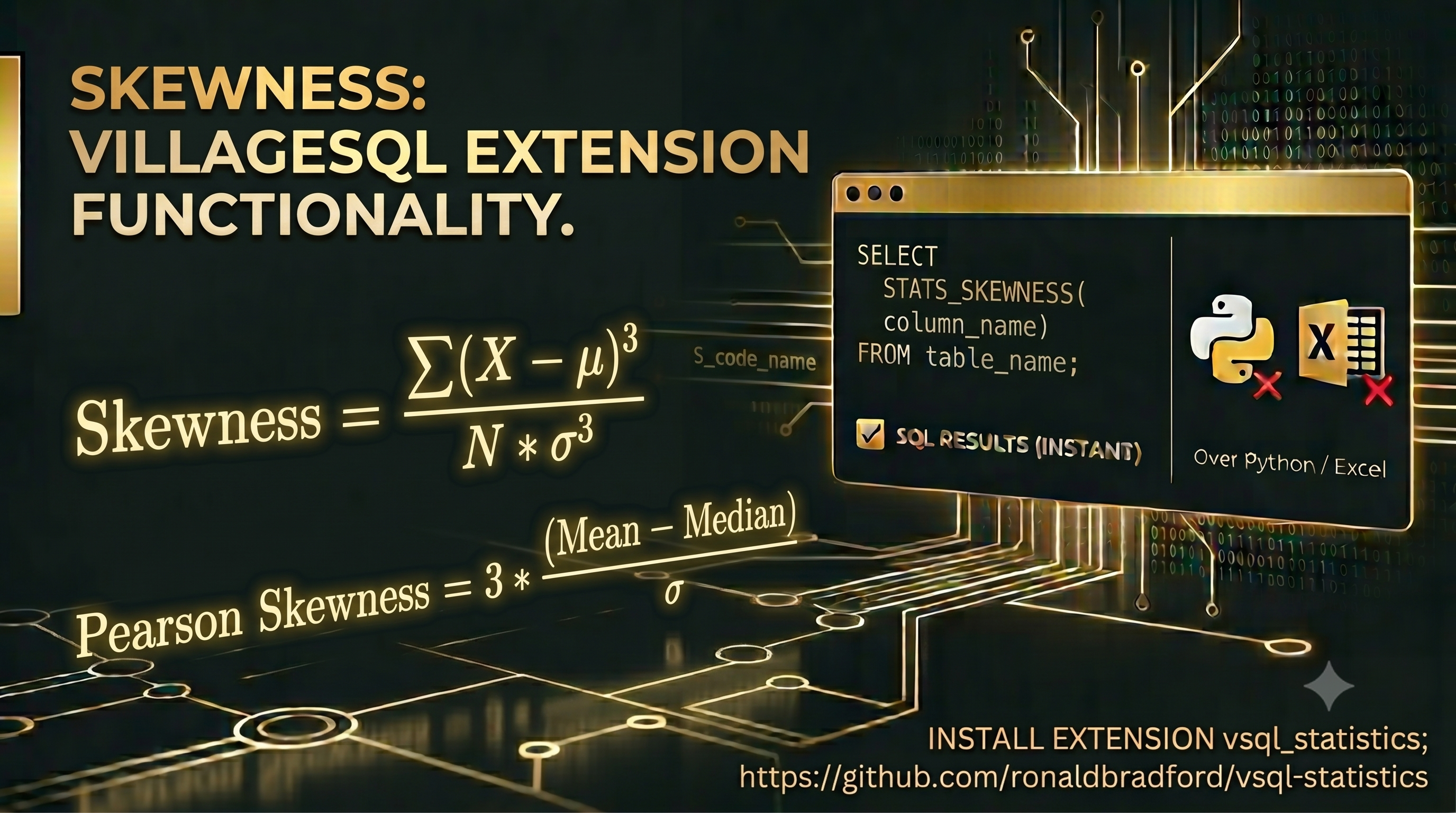
Producing Skewness statistics with SQL

Skewness measures the asymmetry of a distribution. A perfectly symmetric distribution has a skewness of zero. A positive skew (right-skewed) means the tail extends to the right — a small number of high values pull the mean above the median.
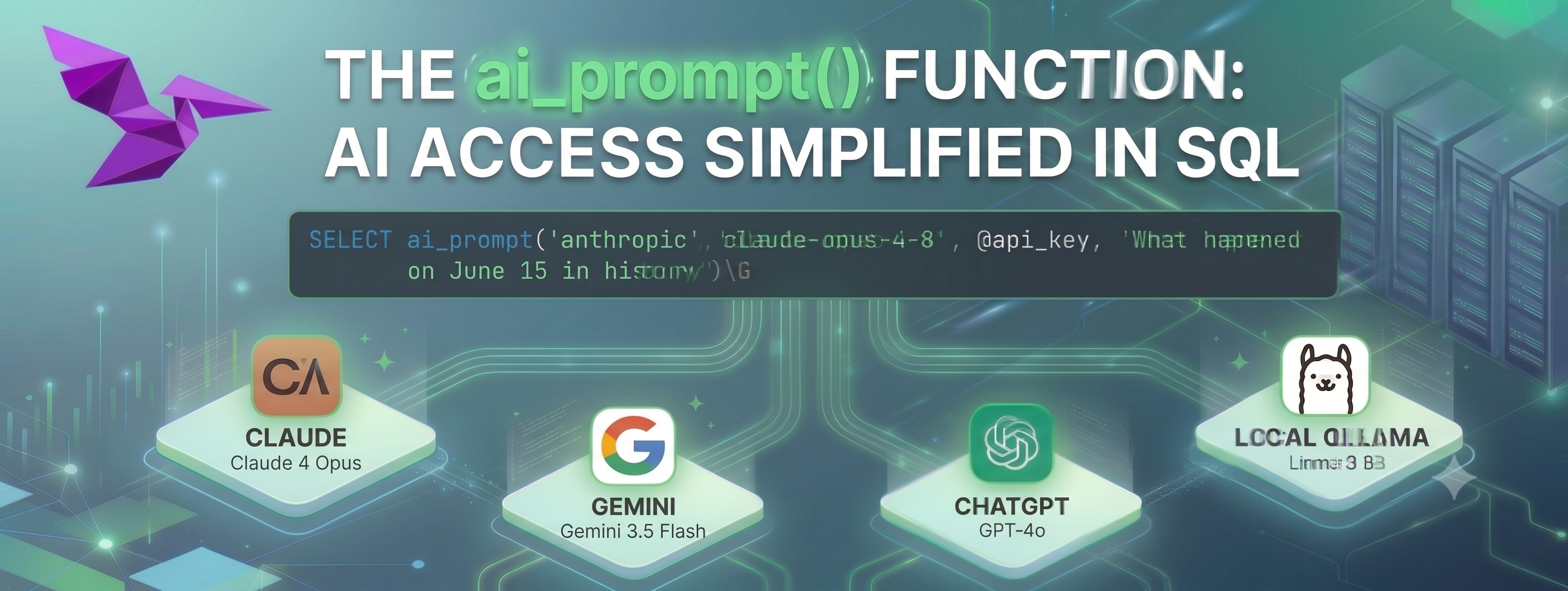
Exploring the vsql-ai extension

The vsql-ai extension adds AI prompt capabilities and text embeddings directly in SQL queries, with support for Anthropic Claude , Google Gemini , OpenAI ChatGPT , or a local LLM such as Ollama .

Producing Chi-Squared statistics with SQL

The Chi-Squared test is one of the most widely used statistical tests for categorical data. It comes in two flavors: the goodness-of-fit test asks whether an observed frequency distribution matches an expected one, while the test of independence asks whether two categorical variables are associated with each other.