Reading the right MySQL Manual

I learned an extremely valuable lesson today on a client site. It’s important that users of MySQL read the right version of the manual for the product they are using. It’s very easy to just goto http://dev.mysql.com/doc/ which is what I type in directly and browser the manual. While the MySQL Manual has separate sections for 4.x, 5.0, 5.1 etc, the 5.0 Manual for example reflects the most current version of MySQL 5.0. You may not be running the most current version, infact most production systems rarely run the current version.

My specific case was with Connector/J (JDBC) Reference of 5.0.4. The manual pages reflects the new 5.0.5 or todays’ 5.0.6 release and a particular default is now a different value. With Connector/J the docs are bundled with the version. The MySQL Community Server product does not bundle the manual, and I don’t know where to view instances of the MySQL manual for each specific dot release!
Tagged with: Databases MySQL

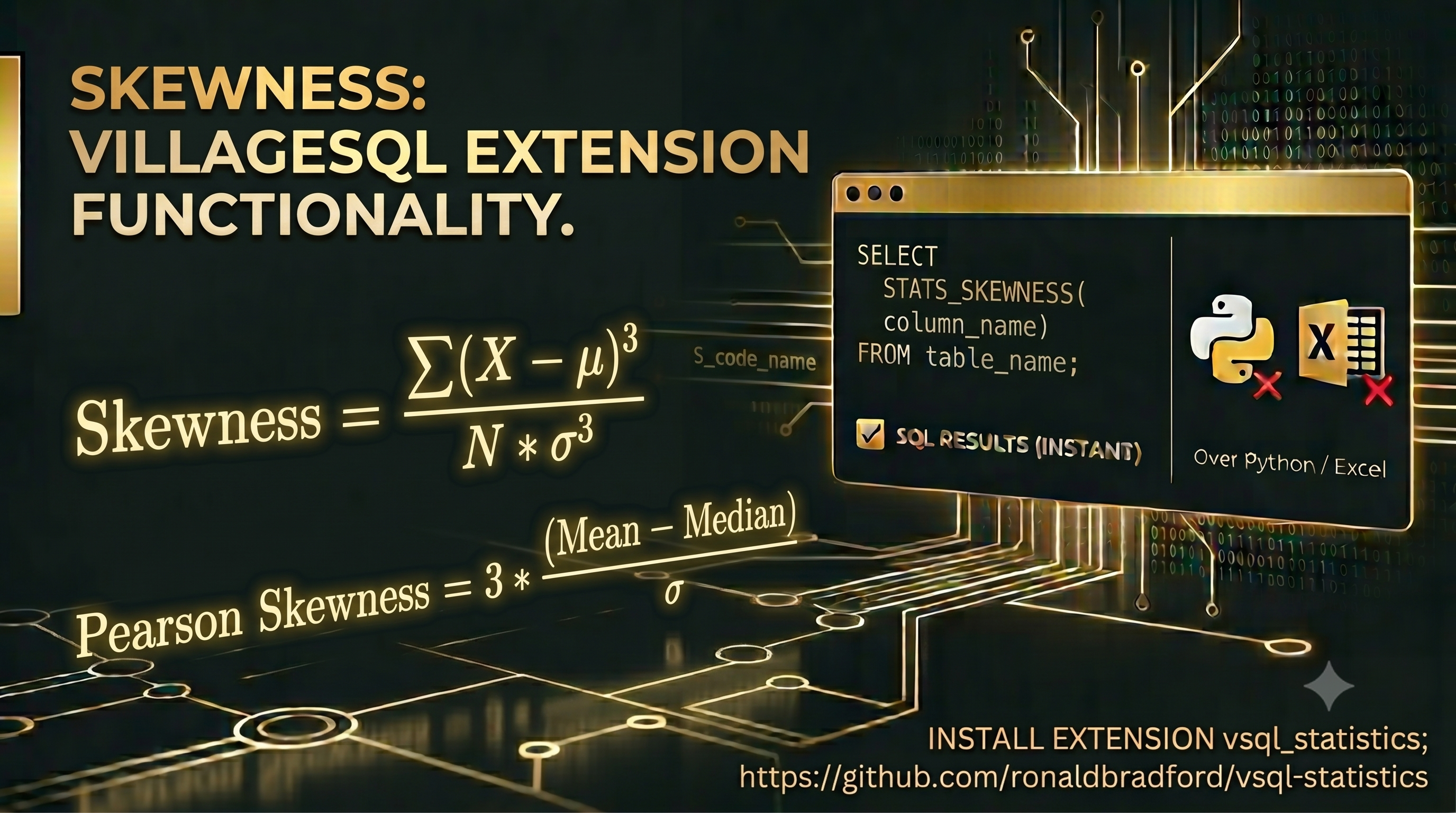
Producing Skewness statistics with SQL

Skewness measures the asymmetry of a distribution. A perfectly symmetric distribution has a skewness of zero. A positive skew (right-skewed) means the tail extends to the right — a small number of high values pull the mean above the median.

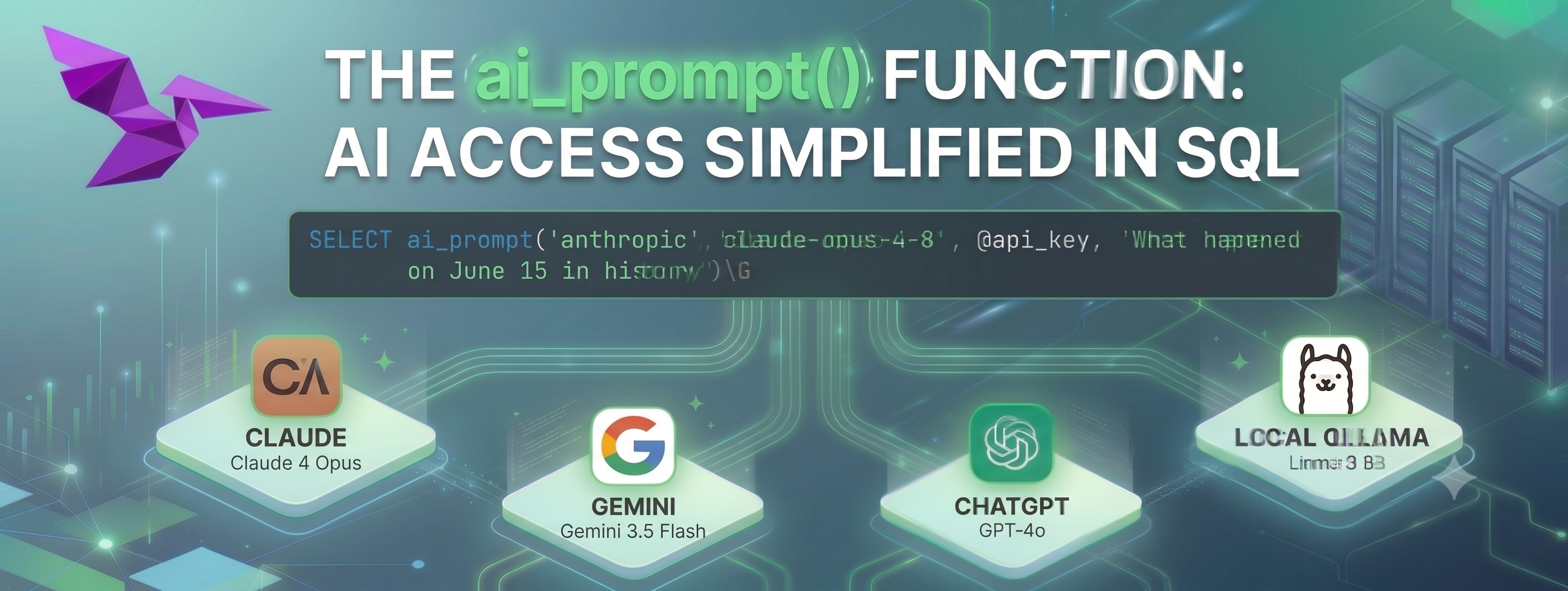
Exploring the vsql-ai extension

The vsql-ai extension adds AI prompt capabilities and text embeddings directly in SQL queries, with support for Anthropic Claude , Google Gemini , OpenAI ChatGPT , or a local LLM such as Ollama .

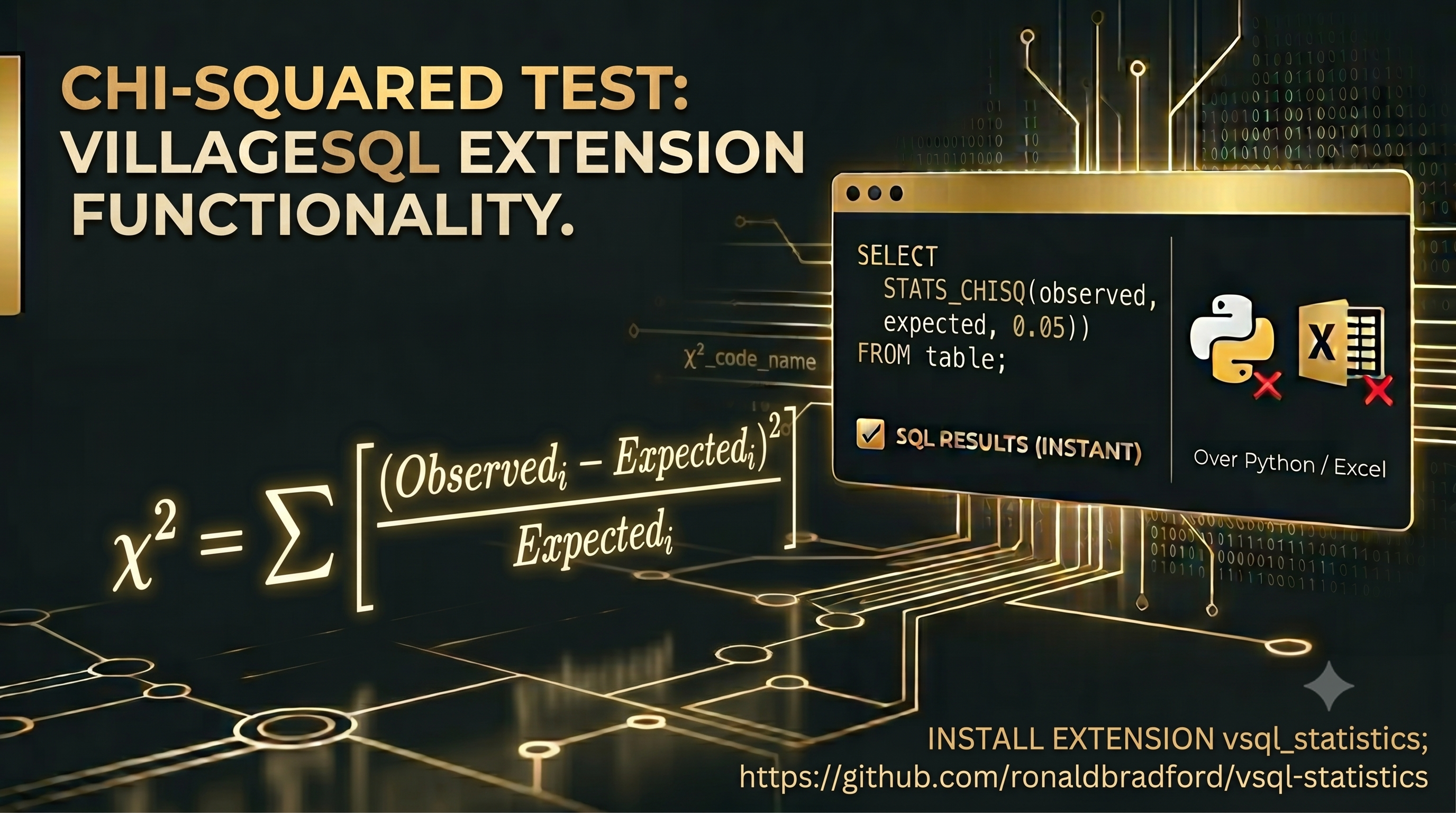
Producing Chi-Squared statistics with SQL

The Chi-Squared test is one of the most widely used statistical tests for categorical data. It comes in two flavors: the goodness-of-fit test asks whether an observed frequency distribution matches an expected one, while the test of independence asks whether two categorical variables are associated with each other.